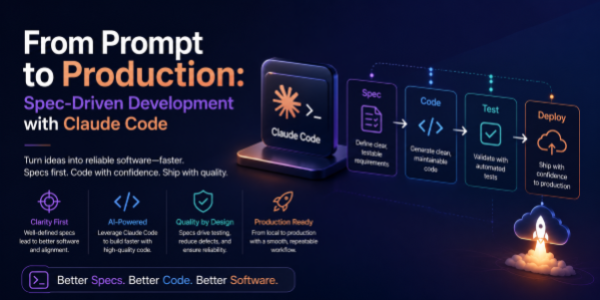
From Prompt to Production: Spec-Driven Development with Claude Code
About the Course:
AI coding tools changed what's possible. They didn't change what's good. The developers getting 10x results from Claude Code aren't typing faster prompts; they're thinking before they prompt. They write specs the way senior engineers write design docs: clear goals, explicit non-goals, verifiable acceptance criteria. Then they hand the spec to the agent and let it work.
This workshop shows you that shift, live. We'll start by deliberately vibe-coding a real feature and watching it go sideways, the same way it goes sideways in your editor every week. Then we'll rebuild the same feature spec-first and watch Claude Code nail it. By the end, you'll understand why specs work, what makes a good one, and how to integrate the workflow into your day-to-day without bureaucratic overhead.
No fluff, no slides marathon. Two live builds, one template, one workflow you'll actually use.
Why This Course, Why Now?
Why this course: Spec-driven development is the single highest-leverage skill for anyone using AI coding tools today, and almost nobody is teaching it well. The blog posts are vague. The Twitter threads are aspirational. What people need is to see it work on a real feature, see the failure mode, see the fix, and see the template. A live workshop with demos is the format that actually transfers the skill.
Why now?
Three things converged in the last 6 months. First, Claude Code went from a CLI curiosity to the default agentic coding tool for a huge slice of professional developers. CLAUDE.md, plan mode, subagents, and skills are now mature enough to support a serious methodology. Second, teams that adopted AI coding tools in 2024-2025 are hitting the wall: individual productivity is up, but quality, consistency, and onboarding are getting worse. Spec-driven development is the answer that's emerging from the trenches. Third, the broader industry is starting to formalize this. Anthropic, GitHub, and others are publishing guidance on agentic workflows, and the early adopters who learn the methodology now will be the ones writing the playbooks in 12 months. Late 2026 is the moment to get ahead of this, not behind it.
Course Objectives:
By the end of this workshop, you will be able to:
- Diagnose why vibe-coded Claude Code sessions fail on non-trivial tasks, and recognize the symptoms in your own workflow.
- Write a production-quality spec using a five-section template (goal, non-goals, interfaces, acceptance criteria, constraints) that an AI agent can execute against reliably.
- Operate Claude Code in spec-driven mode, using CLAUDE.md, plan mode, and self-verifying acceptance criteria to keep agents on track.
- Iterate on specs when the agent surfaces ambiguity, edge cases, or missed requirements mid-build, without losing momentum.
- Integrate spec-first thinking into your existing workflow without turning it into bureaucratic overhead, so you actually use it on Monday.
Who is the Target Audience?
This workshop is built for a mixed room. You'll get value if you're:
- A developer already using Claude Code (or Cursor, Copilot, Cline, etc.) who's frustrated that complex tasks keep going off the rails
- A developer new to AI coding tools who wants to start with the right methodology instead of having to unlearn vibe-coding later
- An engineering lead or tech lead evaluating how to roll out AI coding tools across a team without sacrificing code quality
- A senior or staff engineer looking to formalize what you already do intuitively, so you can teach it to your team
- A founder or solo builder shipping real features with AI assistance who needs the output to actually work
- You'll get less value if you're looking for a "your first prompt" beginner intro, or if you want a deep dive into the Claude Code internals (this is methodology-first, tool-second).
Basic Knowledge:
To get the most out of the workshop, you should have:
- Comfortable writing code in at least one language (JavaScript, Python, Go, anything). The demos will use a mainstream stack, but the methodology is language-agnostic)
- Basic familiarity with the command line, running commands, navigating directories, and editing files
- Some exposure to AI coding tools, you've used Claude, ChatGPT, Copilot, or Cursor at least a few times for coding tasks (you don't need to have used Claude Code specifically)
- A working Claude Code install is recommended but not required; you can absolutely watch the demos and apply the methodology to whatever tool you use; we'll point out where things translate to Cursor, Cline, etc.
- What you don't need: prior experience with formal specs, design docs, or RFC processes. We're teaching a lightweight version designed for AI agents, not the heavyweight version designed for distributed teams.
Welcome & Setup
- Workshop format, how to ask questions, what you'll walk away with
- Quick poll: where is everyone on the Claude Code spectrum?
The Hook: Watching Vibe Coding Fail
- Live demo: a real feature, prompted casually, run end-to-end
- What went wrong, and why it's not the agent's fault
- The pattern: why "smart prompts" hit a ceiling fast
The Reframe: What Spec-Driven Development Actually Is
- The core insight: the spec is the contract, the agent is the implementer
- Where the thinking happens vs. where the typing happens
- The five-section spec template, introduced
The Redemption Build: Same Feature, Spec-First
- Writing the spec live, section by section
- Loading context with CLAUDE.md
- Running Claude Code in plan mode against the spec
- Watching it ship - and pausing for audience questions
Anatomy of a Great Spec
- What makes acceptance criteria self-verifiable
- Goals vs. non-goals - why non-goals matter more than people think
- When to split a spec, when to keep it whole
- CLAUDE.md vs. spec vs. inline prompts - what goes where
- Live critique: a bad spec, fixed in real time with audience input
The Harder Build: Iterating When Reality Pushes Back
- Multi-file feature with genuine ambiguity
- What to do when the agent surfaces a question the spec didn't answer
- Updating the spec vs. overriding in chat - when each is right
- Subagents and parallel work, where they fit
The Monday Morning Workflow
- The full loop, one slide
- The spec template you're taking home
- What to try first, what to try second, what to avoid
- Q&A and close