Root Cause Analysis (RCA) with Artificial Intelligence (AI)
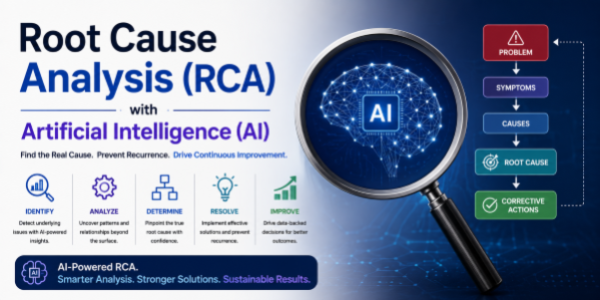
Learn how to integrate AI tools with traditional Root Cause Analysis to identify operational failures, run smarter analyses, and implement more effective corrective actions.
Duration: 2 Days
Hours: 6 Hours
Training Level: All Levels
Batch One
Wednesday, July 01, 2026
01:00 PM - 04:00 PM (Eastern Time)
Most Popular
About the Course:
In modern operational environments, identifying why problems occur is essential, yet traditional Root Cause Analysis (RCA) can often be slow, resource-heavy, and susceptible to human bias. Integrating Artificial Intelligence (AI) into the RCA workflow allows teams to analyze large datasets, spot hidden patterns, and identify systemic issues with greater speed and precision.
This course bridges the gap between structured problem-solving methodologies and AI. Participants will learn practical techniques to use AI assistants and analytics to guide failure analysis, automate data correlation, and streamline corrective and preventive action (CAPA) processes.
Course Objectives:
- Understand how AI can support and enhance traditional Root Cause Analysis (RCA) methodologies.
- Learn how to write effective prompts to guide AI models through the structured problem-solving process.
- Explore AI-assisted techniques for parsing unstructured operational data, customer feedback, and incident reports.
- Learn how to generate and refine 5 Whys analyses and Fishbone (Ishikawa) diagrams with AI collaboration.
- Discover how to leverage AI to design, evaluate, and prioritize corrective and preventive actions (CAPA).
- Address critical considerations around data privacy, accuracy, and the necessity of human oversight in AI-driven analysis.
Who is the Target Audience?
- Quality Assurance (QA) and Quality Control (QC) Professionals
- Operations Managers, Site Reliability Engineers, and Process Engineers
- Six Sigma Green Belts, Black Belts, and Lean Practitioners
- Risk Management and Compliance Officers
- Operations and Customer Support Leaders
Basic Knowledge:
- A basic understanding of structured problem-solving concepts or standard RCA tools (e.g., Fishbone, 5 Whys) is helpful but not mandatory.
Curriculum
Total Duration: 6 Hours
Introduction to AI-Driven Root Cause Analysis
- Traditional RCA vs. AI-Enhanced RCA: Understanding the limitations of manual analysis and where AI adds efficiency.
- Cognitive Bias Mitigation: How AI can serve as an objective partner to prevent premature conclusions.
- Overview of AI Models & Tools: Which generative and analytical AI tools are best suited for problem-solving.
Automated Data Gathering & Timeline Construction
- Handling Unstructured Data: Analyzing incident logs, customer support tickets, and emails with AI to find key timelines.
- Identifying Anomaly Patterns: Spotting trends and recurring factors across historical data.
- Practical Case Study: Building a clear failure timeline using AI parsing.
Core Problem-Solving Tools with AI Collaboration
- AI-Assisted "5 Whys" Analysis: Prompting AI to drill down into deeper logical levels without circular reasoning.
- Generative Fishbone (Ishikawa) Diagrams: Using AI tools to map out cause categories (People, Process, Machinery, Material, etc.) dynamically.
- AI-Driven Failure Mode & Effects Analysis (FMEA): Accelerating risk identification and prioritization.
Designing Smarter Corrective & Preventive Actions (CAPA)
- Generating Solutions: Using AI to brainstorm feasible, cost-effective corrective and preventive actions.
- Predictive Verification: Evaluating potential secondary risks or downstream impacts of proposed solutions using AI scenarios.
- Drafting Action Plans: Documenting CAPA reports and updating standard operating procedures (SOPs) with AI support.
Human-in-the-Loop, Ethical AI, & Practical Prompts
- Human Oversight: Managing the critical balance between AI-generated insights and professional engineering judgment.
- Data Privacy & Security: Crucial guardrails when uploading internal process data to public or private AI models.
- Prompt Library: Practical, copy-and-paste prompts for immediate use in operational troubleshooting.
Review, Action Planning
- Interactive Review: Identifying which of your current operational bottlenecks can be optimized using AI.
- Summary of Key Takeaways: Core methodologies to implement post-training.