Value Stream Mapping (VSM) Certification Program: Eliminate Waste and Streamline Workflows
About the Course:
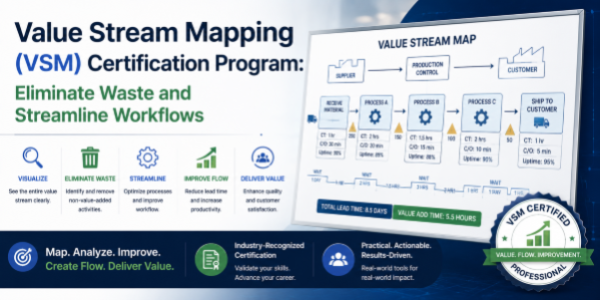
Value Stream Mapping (VSM), originally developed as material and information flow mapping at Toyota, is a foundational Lean tool used to analyze and optimize the end-to-end flow of activities required to deliver a product or service.
This globally accredited certification program equips professionals with a practical framework to identify non-value-added waste across both material and information flows. By learning to map your current-state process and design an optimized future-state stream, you will learn how to systematically reduce lead times, improve throughput, and establish a culture of continuous improvement in your organization.
Learner Benefits:
Master Value Stream Mapping: Understand process visualization techniques to analyze and improve workflows from beginning to end.Target Waste Elimination: Systematically isolate and eliminate non-value-added activities.Design Future-State Processes: Build efficient future-state plans aligned with strategic business goals.Data-Driven Decision Making: Rely on real process metrics (cycle times, lead times) to solve systemic issues.Execution-Ready Skills: Draft practical, ready-to-implement project roadmaps to execute immediately
Course Objectives:
- Learn the five core Lean principles and how to systematically identify the "Seven Wastes" in operational workflows. Master the VSM framework to map end-to-end processes using real-world operational data. Identify process bottlenecks, inventory build-ups, and information flow delays.
- Apply design concepts, such as Takt Time, continuous flow, pull systems, and supermarkets, to build an optimized future-state map. Transition from map to execution by building actionable, time-bound implementation plans. Form, guide, and collaborate effectively with cross-functional VSM project teams.
Who is the Target Audience?
- Operations Leaders: Operations Managers, Plant Heads, and Supervisors are driving daily performance.
- Process Engineers: Manufacturing, Industrial, and Production Engineers tasked with process optimization.
- Supply Chain Specialists: Logistics and Supply Chain Professionals managing material and information flow.
- Continuous Improvement Practitioners: Lean Six Sigma Green Belts, Black Belts, and Quality Professionals.
- Cross-Functional Leaders: IT & Project Managers, Product Developers, and Finance Professionals involved in process transformations.
Basic Knowledge:
- No strict prerequisites are required. A basic familiarity with organizational processes or operational workflows is helpful.
Module 1: Lean Foundations & Waste Identification
- The Five Lean Principles: Value, value streams, flow, pull, and perfection.
- The Seven Wastes: Eliminating overproduction, waiting, inventory, motion, defects, over-processing, and transportation.
Module 2: Introduction to Value Stream Mapping (VSM)
- Understanding the purpose, benefits, and modern organizational needs of VSM.
Module 3: VSM Development Framework
- Step-by-step setup, selecting product/service families, and establishing your cross-functional team.
Module 4: Current State Mapping
- Practical exercises in documenting process steps, identifying process cycle times, delays, and documenting information flow.
Module 5: Future State Design
- Designing the optimized future-state map using Takt Time, pull systems, and continuous flow.
- Aligning process improvements with core business goals.
Module 6: Implementation Planning & Execution
- Converting future-state maps into action items with assigned ownership and timelines.
Module 7: Hands-on VSM Application
- Interactive case studies, simulation exercises, and selecting immediate, high-impact projects for your organization.
Module 8: Closure & Knowledge Reinforcement
- Open Q&A session, key takeaways, and guidelines for maintaining continuous improvement gains.